
Minnie Lois Murphy (1901–1962)
Minnie Lois Murphy came of age as an artist in the late 1920s, exhibiting at the Pennsylvania Academy of the Fine Arts before showing in Provincetown and at the Brooklyn Museum. She worked in watercolor as well as in lithography and wood engraving. It was her work as a printmaker that brought her into the WPA’s Federal Art Project and accounts for much of her presence in American museum collections today.
Born in Lyons, Kansas, Murphy graduated from Columbia University and studied at the Art Students League in New York with Boardman Robinson and George Grosz. By the early 1930s she was exhibiting with the Provincetown Art Association and at the Art Institute of Chicago. Her lithograph Provincetown Playhouse dates from this period of her career. In her early lithographs, she sometimes used the angular forms of Cubism to organize village buildings and the landscape around them.
During the Depression, the New York City division of the Federal Art Project published several of Murphy’s wood engravings. She found subjects in the ordinary public life of the city, including lunch counters, fish markets, and Coney Island sideshows. Her exhibition record extended beyond New York and New England. In 1937, her work appeared in the Northwest Printmakers’ annual exhibition at the Seattle Art Museum.
Murphy’s prints are held by the Metropolitan Museum of Art, the National Gallery of Art, and the Delaware Art Museum. The original watercolors at Printed & Painted give a fuller view of her practice alongside the lithographs and wood engravings for which she is best known.
Available Works
Working Waterfront
Minnie Lois Murphy
Pastel with dark linework on paper (probable)
14 × 19 inches (sheet)
Unsigned. Acquired as part of a group of works by Minnie Lois Murphy.
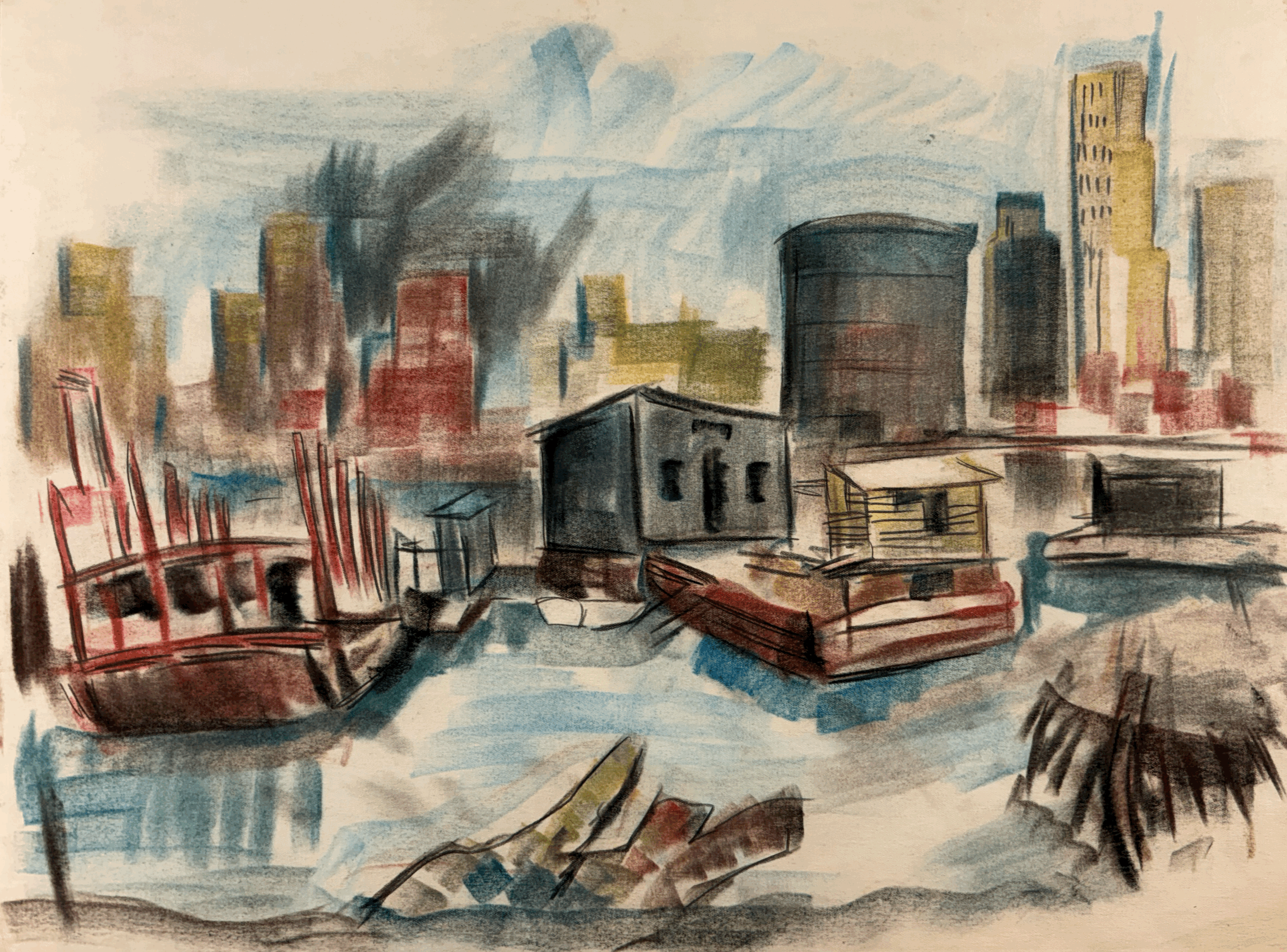
Murphy builds the skyline from overlapping blocks of ochre, brick red, and charcoal gray. The upright pilings at left pick up the rhythm of the distant towers, while the angled hulls interrupt it. Broad strokes of blue run through both water and sky, with the cream paper showing through. A few sharply drawn windows, rooflines, and boat edges hold the waterfront in view as the city behind it dissolves into blocks of color.
Condition
Light age toning and scattered spotting, with a diagonal crease at the upper-right corner and minor edge wear.
Descriptive title supplied by Printed & Painted.
Curved Mansard Roof
Minnie Lois Murphy
Pastel with dark linework on paper (probable)
14 × 19 inches (sheet)
Unsigned. Acquired as part of a group of works by Minnie Lois Murphy.
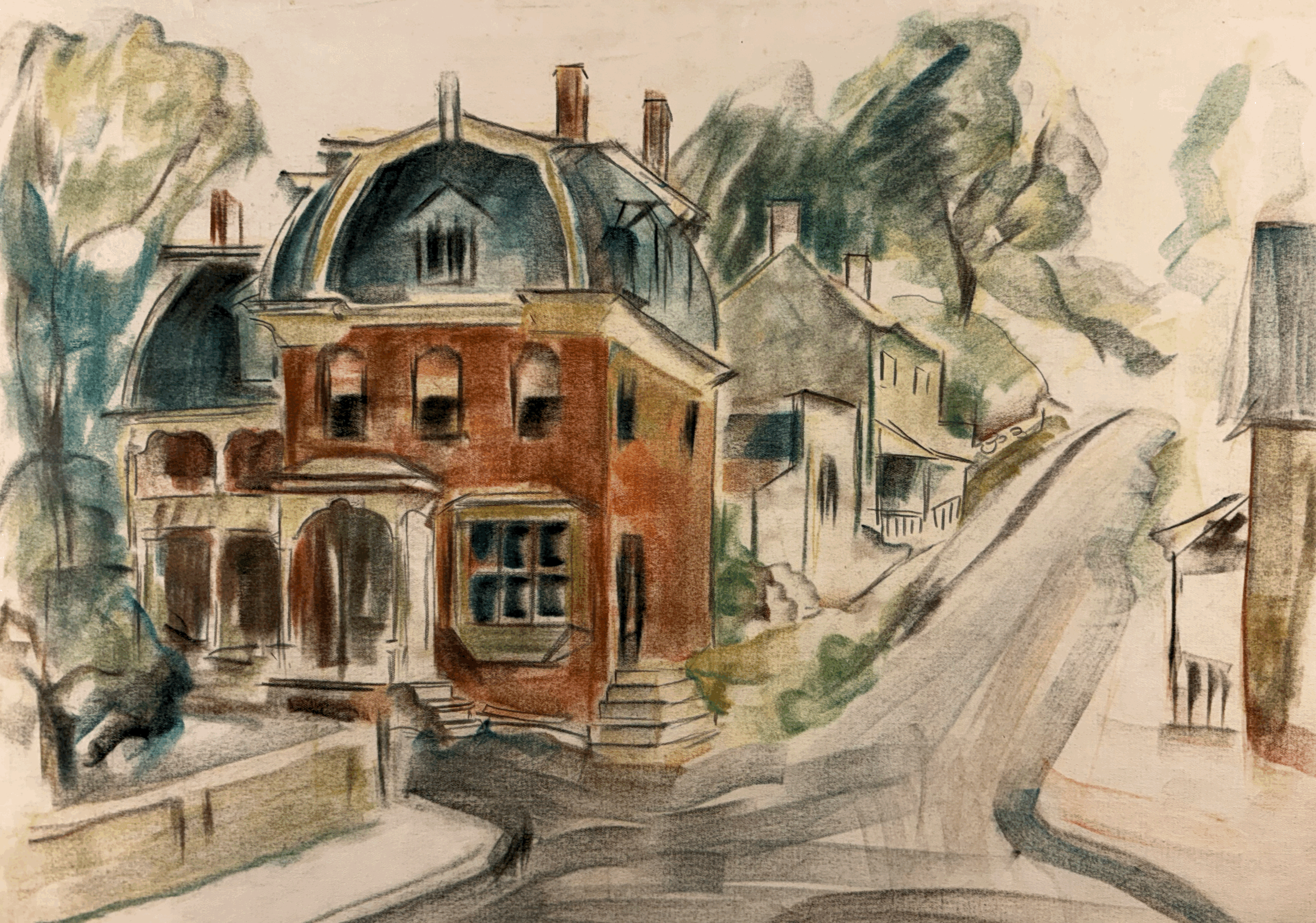
Murphy sets the blue-gray curve of the mansard roof against a rust-red façade, picking out its profile with a narrow band of ochre. The arc reappears in the window openings and in the sweep of the road as it climbs past the house. Farther uphill, the architecture loosens into pale blocks of color and exposed paper, giving the street scene an increasingly abstract rhythm.
Condition
Light age toning and scattered spotting, with a short tear at the upper edge and small losses at the upper- and lower-right corners.
Descriptive title supplied by Printed & Painted.
The Narrow Lane
Minnie Lois Murphy
Pastel and watercolor wash with pencil linework on paper
11 × 14 inches (sheet)
Signed “M. Lois Murphy” lower right
Undated
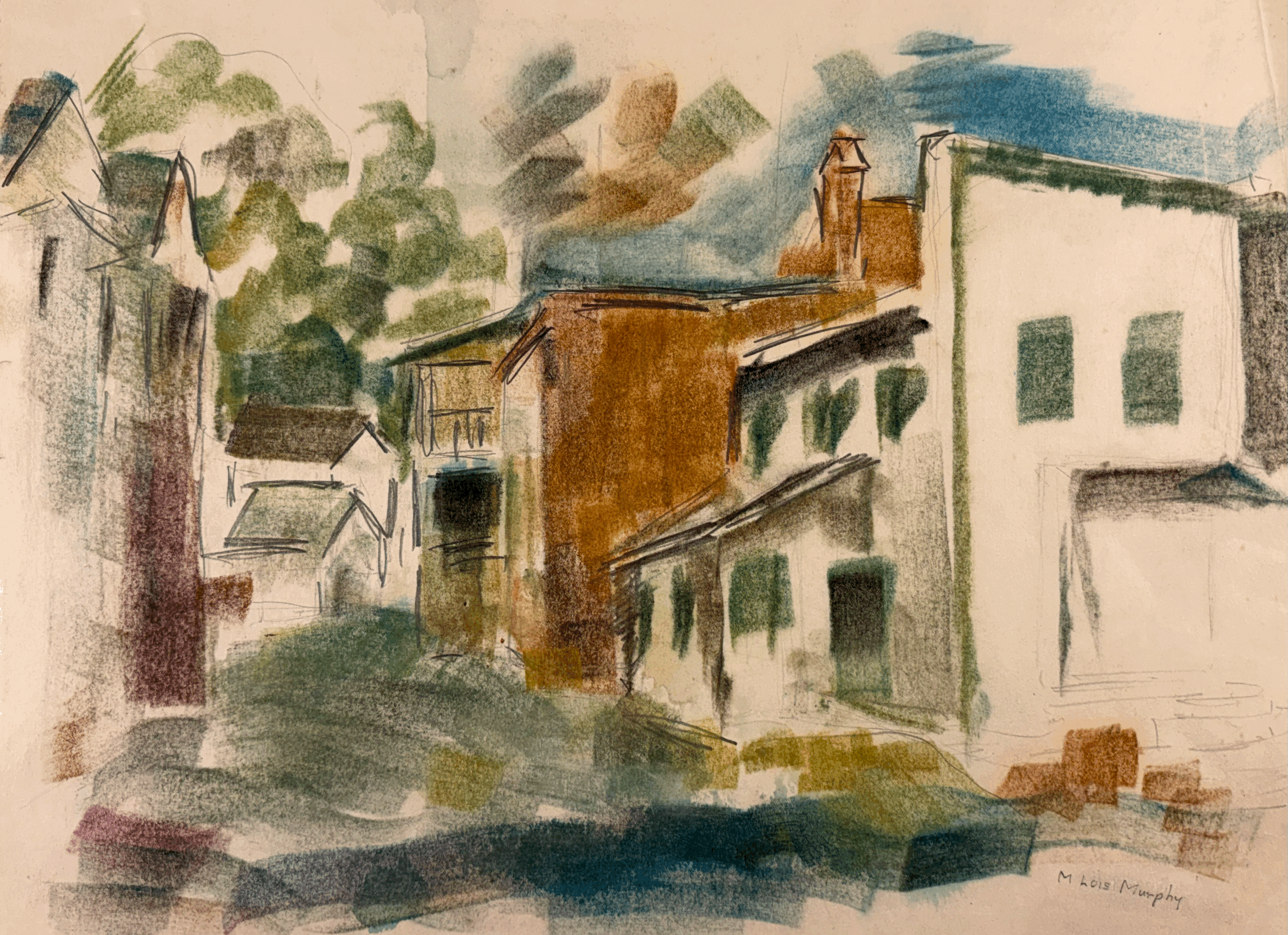
A narrow lane recedes between closely spaced buildings, with small gabled roofs and trees visible at the far end. Murphy reduces the façades to broad planes of ochre and cream, using the bare paper for the pale wall at right and blocks of green for its windows. Fine lines pick out roof edges and steps, while broad strokes of blue and violet carry the shadows across the foreground.
Condition
The sheet shows age toning, a crease near the upper-right corner, and a small notch along the lower edge.
Descriptive title supplied by Printed & Painted.
Industrial Scene
Minnie Lois Murphy
Pastel with dark linework on paper
11 × 14 inches (sheet)
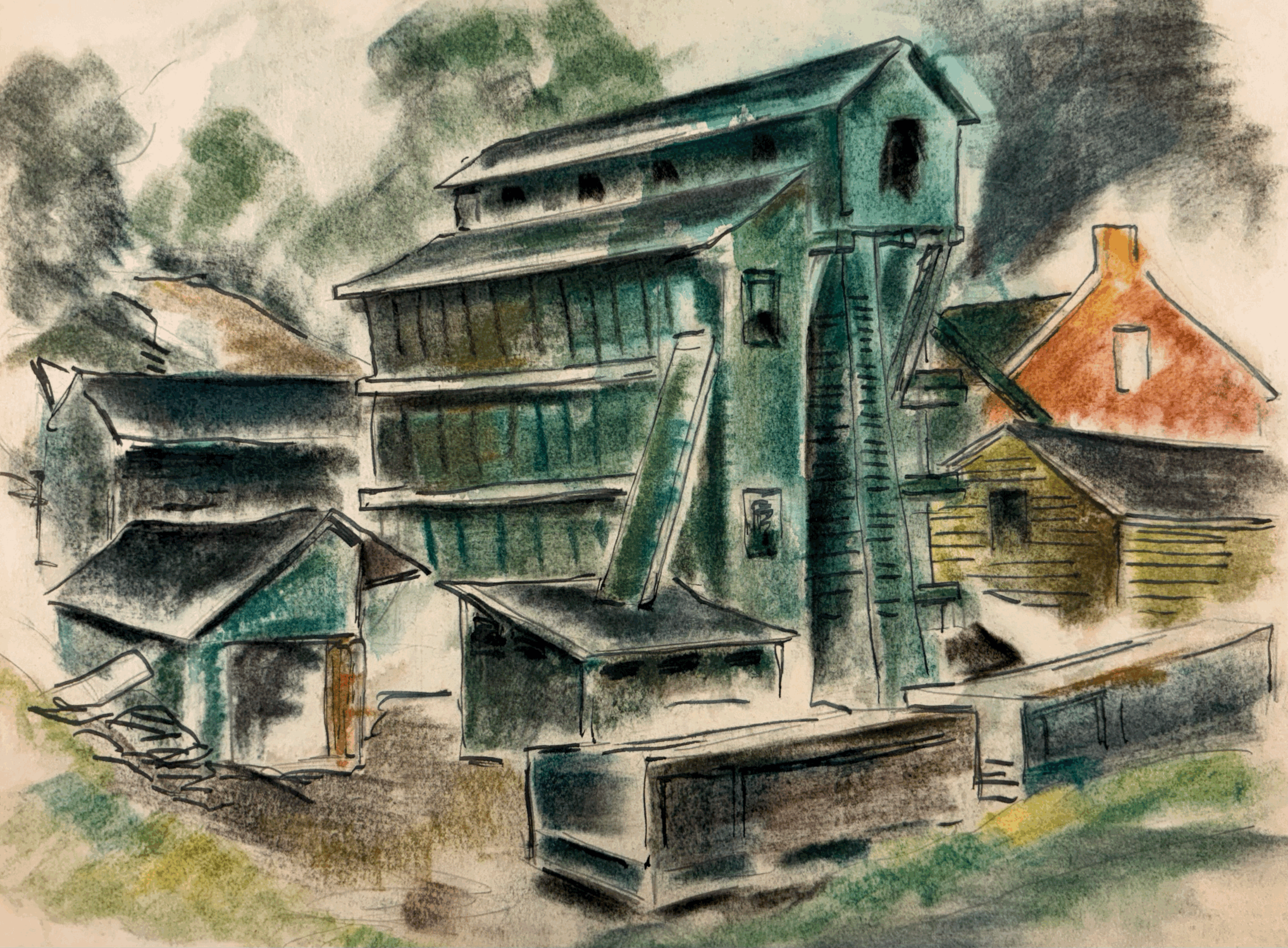
A tall blue-green structure rises above a cluster of sheds and low platforms. Murphy defines the rooflines, ladder, and clapboard siding with quick, dark strokes, while soft passages of green and gray let the trees and shadows fade into the paper. The repeated diagonals give the industrial yard a lively rhythm, and the orange gable at right stands out against the cooler palette.
Condition
Light toning and minor edge wear, with an irregular lower edge and a faint crease near the lower-right corner.
Unsigned. Acquired as part of a group of works by Minnie Lois Murphy.
Descriptive title supplied by Printed & Painted.
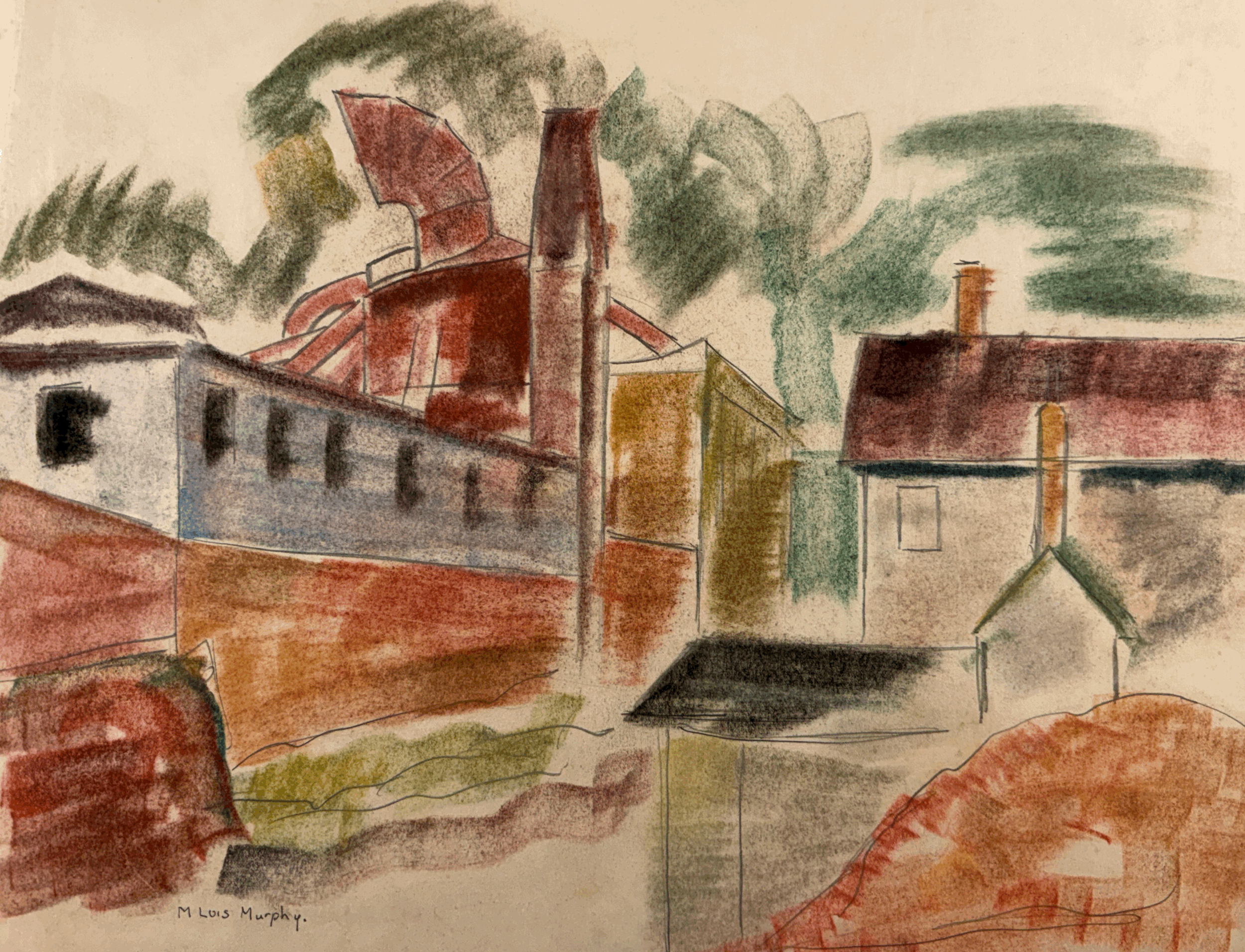
The Mills
Minnie Lois Murphy
Pastel with pencil linework on paper (probable)
10¾ × 14 inches (sheet)
Signed “M. Lois Murphy” lower left
Undated, circa 1930s
In The Mills, Murphy pushes a recognizable industrial scene toward abstraction. Rust red and ochre spread across the foreground and rise into the buildings, while a band of slate blue cuts across the warm colors. Loose arcs of olive green echo the curved red form above the roofline. Fine pencil contours hold the architecture together as the pastel softens and breaks at the edges, allowing the cream paper to show through.
Condition
Light age toning, a faint crease near the upper-left edge, and minor wear along the irregular lower edge, including a small bend at the lower-right corner.
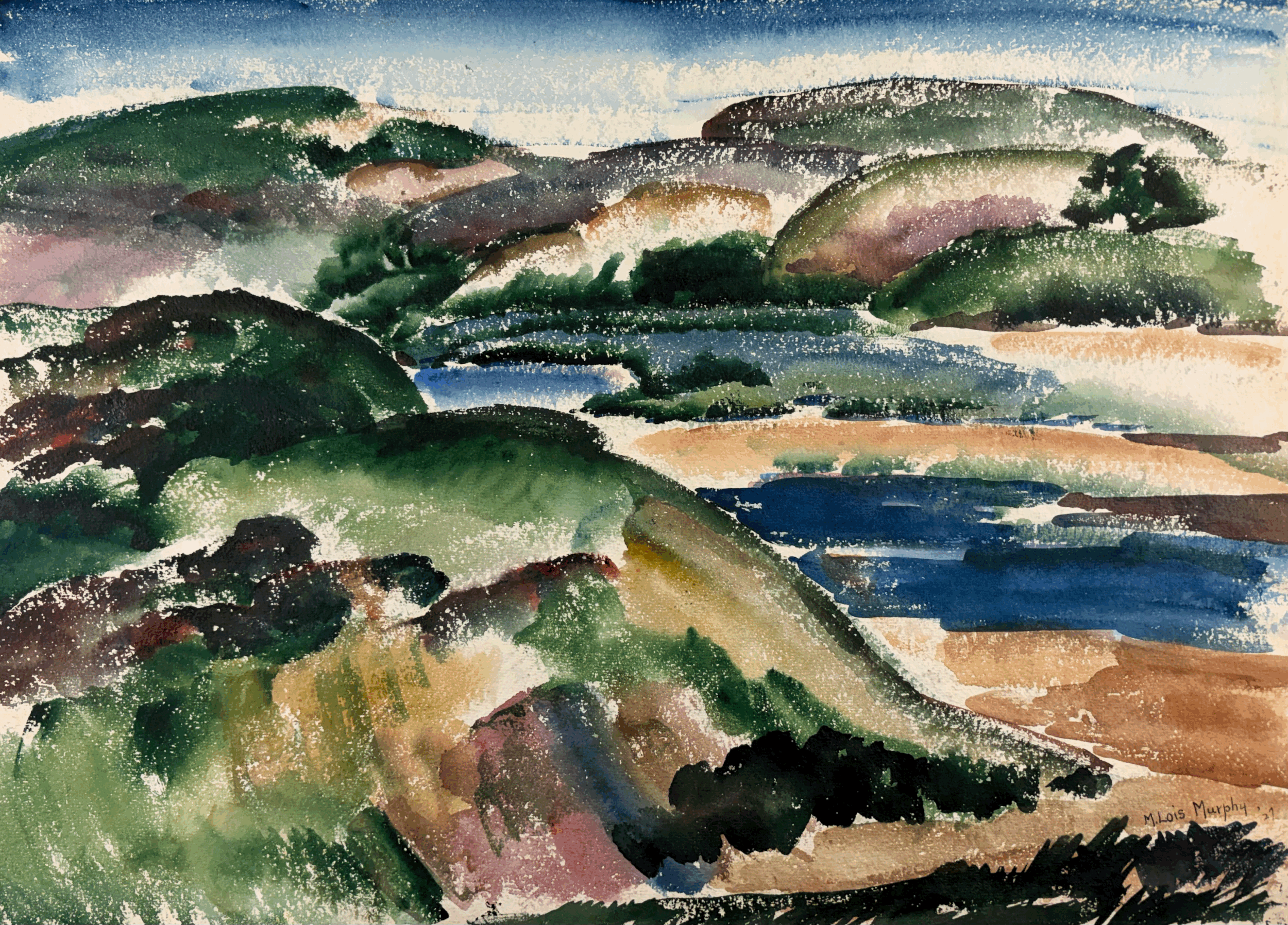
Water Between the Hills
Minnie Lois Murphy
1927
Double-sided watercolor on paper
15¼ × 22 inches (sheet)
Signed and dated “M. Lois Murphy ’27” at lower right on the front
Murphy builds this expansive landscape from overlapping washes of green, violet, and ochre, with bands of deep blue suggesting water between the hills. The brush skips across the textured paper, leaving flecks of white that carry light through the slopes and sky. On the reverse, Murphy revisits the rolling forms in a more open composition, with a small white cottage in the foreground.
Condition
The sheet shows age toning, scattered surface marks, and wear along the edges and corners. Remnants of brown mounting tape are visible along several edges and corners on the reverse.
Descriptive title supplied by Printed & Painted.
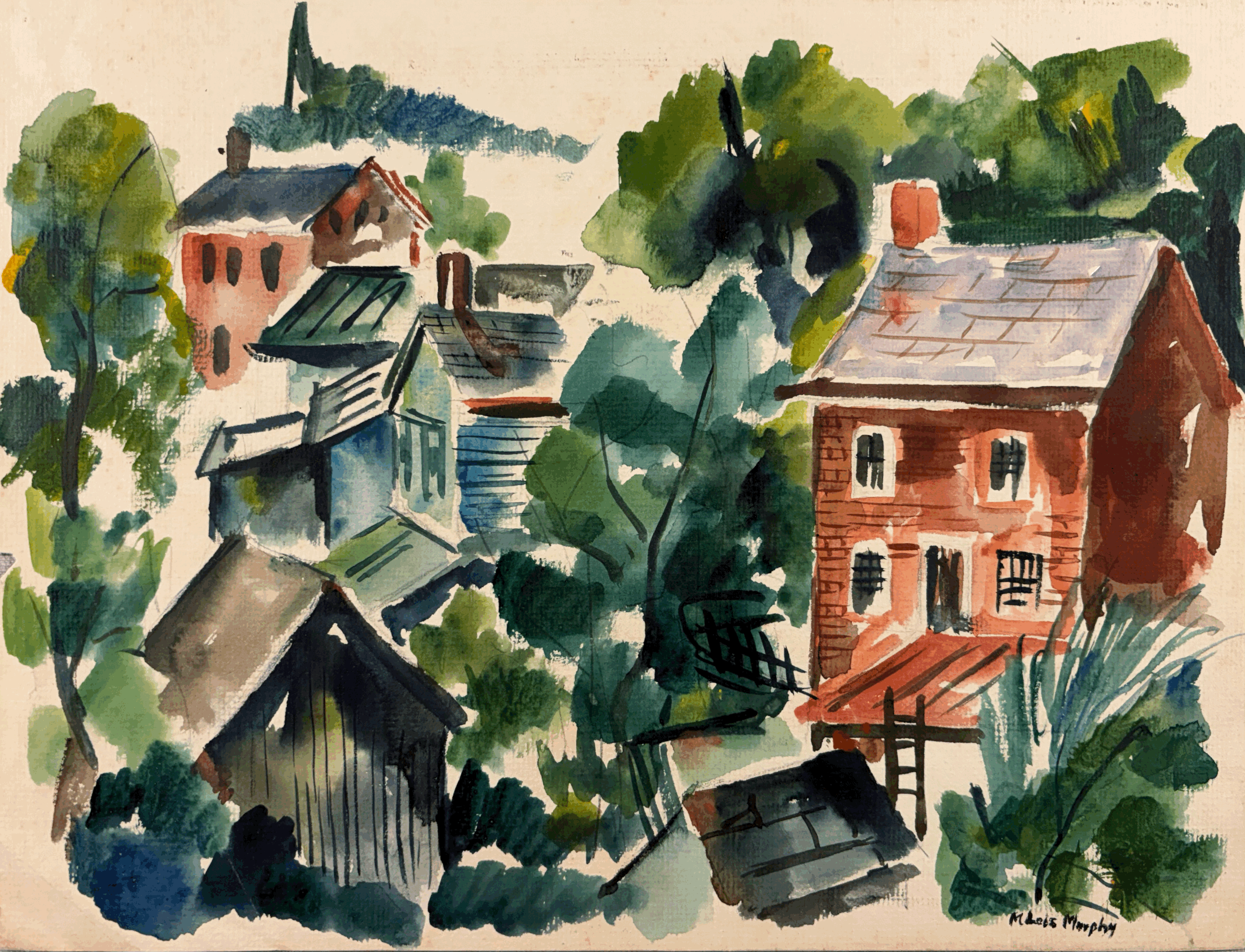
Behind the Village Houses
Minnie Lois Murphy
Watercolor on paper
10 × 13 inches (sheet)
Signed “M. Lois Murphy” lower right and on the reverse
A ladder leans against a low roof beneath the brick-red house at right, while a dark gabled shed anchors the foreground. Murphy stacks rooflines, chimneys, and walls among broad washes of green and blue. The compressed perspective gives the scene a modernist rhythm, with the angles of the buildings recurring across the sheet and patches of bare paper keeping the composition open.
Condition
The sheet shows age toning and scattered spotting, with a small loss along the left edge as viewed from the front. The reverse shows additional marks and discoloration.
Descriptive title supplied by Printed & Painted.
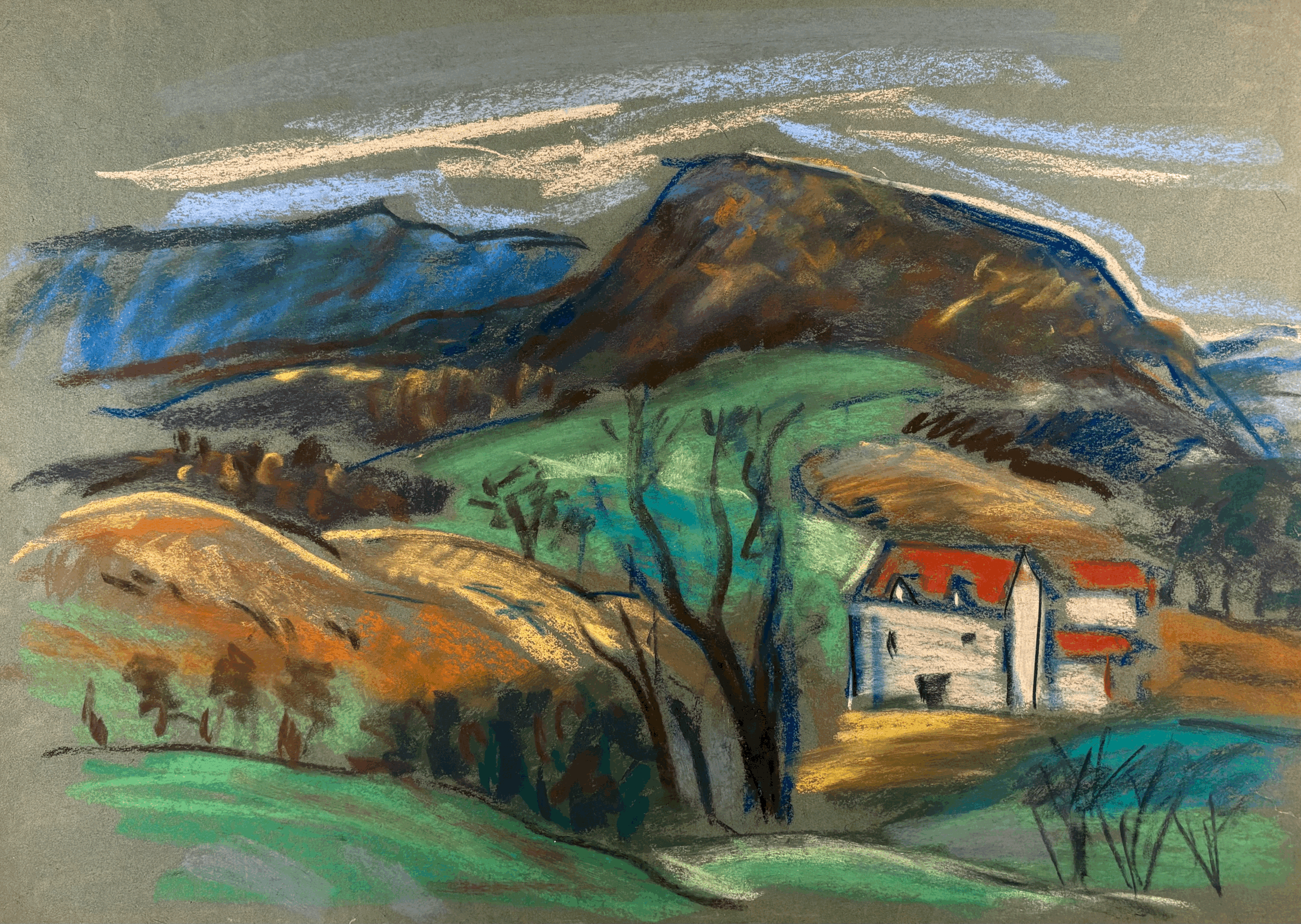
Red Roofs Beneath the Ridge
Minnie Lois Murphy
Pastel on toned paper
17 × 23 inches (sheet)
A cluster of white buildings with red roofs sits below a dark ridge, framed by bare trees and rolling fields. In this large-format pastel, Murphy reduces the landscape to sweeping bands of green, turquoise, and ochre, punctuated by the angular outlines of the buildings. She lets the olive-gray paper show through the sky and foreground, using the tone of the sheet as part of the composition.
Unsigned. Acquired as part of a group of works by Minnie Lois Murphy.
Condition
Edge wear and small losses along the top and right edges and at the corners. A tear extends inward from the lower right edge into the image area, as shown in the detail photograph.
Descriptive title supplied by Printed & Painted.
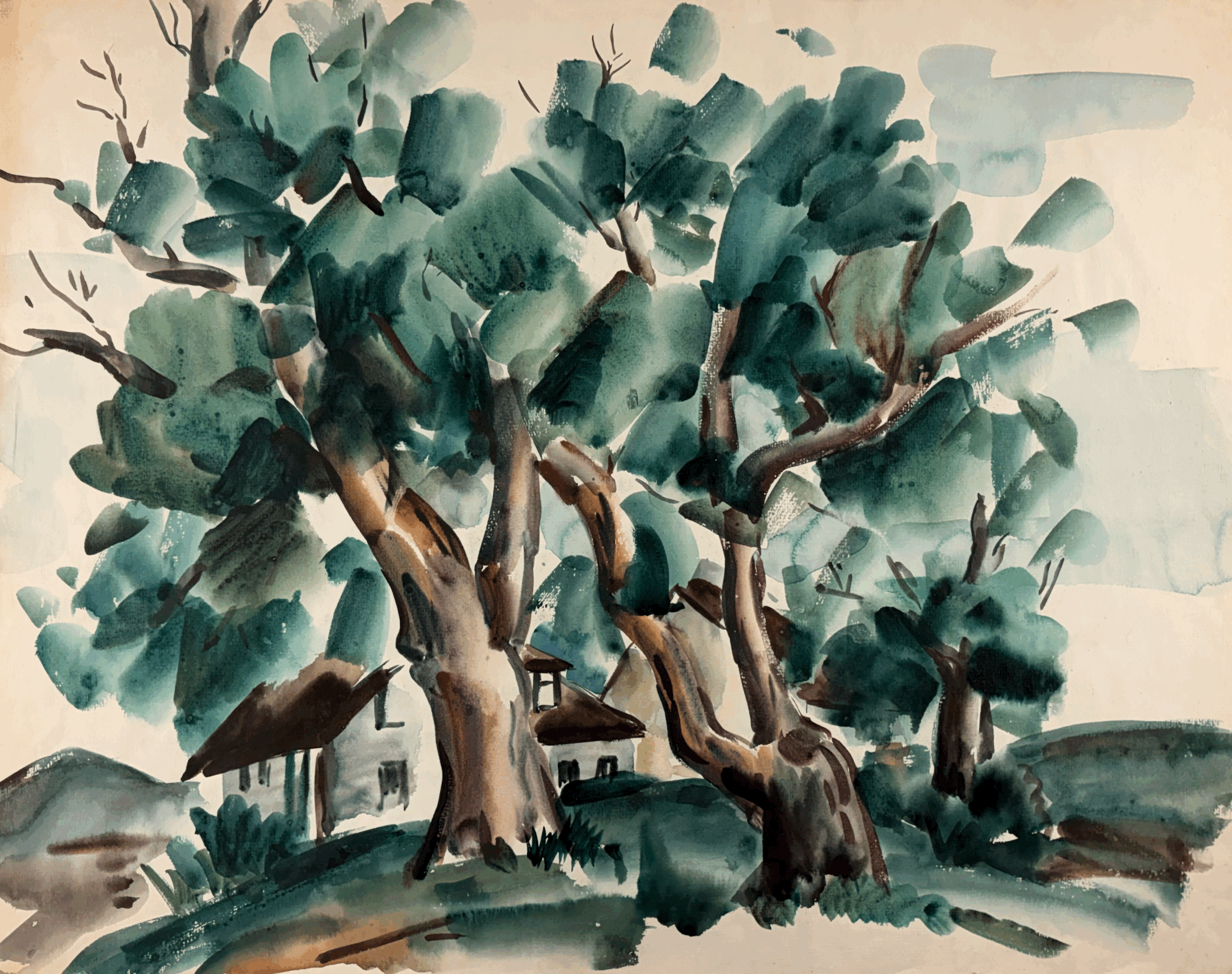
Houses Beyond the Trees
Minnie Lois Murphy
Watercolor on paper
18½ × 24 inches (sheet)
Circa 1930s, Unsigned. Acquired as part of a group of works by Minnie Lois Murphy.
Two twisting trunks dominate this large-format watercolor, with white buildings glimpsed between them and low hills in the distance. Murphy’s modernist approach comes through in the way she builds the canopy from broad, overlapping blue-green washes and leaves patches of bare paper between them. At two feet across, the sheet gives those sweeping brushstrokes room to register individually, while the dark rooflines and warm browns of the trunks anchor the composition.
Condition
Age toning is most apparent along the sheet edges and on the reverse. Light creasing is visible near the corners, and a small piece of mounting tape remains on the reverse along the top edge.
Descriptive title supplied by Printed & Painted.
Village Abstract
Minnie Lois Murphy
Watercolor on paper
14 × 18 inches (sheet)
Unsigned. Acquired as part of a group of works by Minnie Lois Murphy.
Murphy compresses a hillside village into a series of steep diagonals, bands of color, and near-black brushmarks. The umber walls and blue-black siding are laid in with broad strokes, while the windows and stones in the street become repeated dark shapes. A vivid blue wash runs across the top of the sheet, and yellow-green foliage gathers against the dark building at right. Between these dense passages, the bare paper opens up the composition, carrying light from the sky down between the houses.
Condition
Light age toning and minor edge wear, with small nicks along the upper edge and creasing at the lower-right corner.
Descriptive title supplied by Printed & Painted.